How Vertical & Horizontal Scalability Work In Kubernetes?
Kubernetes provides a robust framework for both horizontal and vertical scalability, allowing businesses to adapt to varying workloads efficiently and effectively.
Scenarios

Horizontal Scalability in Kubernetes
Horizontal scalability, also known as scaling out, involves adding more instances (nodes) to distribute the load across a growing number of machines. In Kubernetes, this is achieved by adding more replicas of a pod or by adding more nodes to the cluster. This approach is suitable for scenarios where the workload can be distributed across multiple instances.
Consider an e-commerce application during a flash sale. The number of users accessing the application suddenly increases. Horizontal scalability in Kubernetes allows you to spin up additional replicas of the application’s micro-services to handle the increased load. Each replica can handle a portion of the incoming requests, ensuring that the application remains responsive and available.

Vertical Scalability in Kubernetes
Vertical scalability, or scaling up, involves increasing the resources (CPU, memory) of a single node or instance. In Kubernetes, vertical scalability can be achieved by resizing a pod or by upgrading the node’s instance type. This approach is suitable for scenarios where a single instance requires more resources to handle increased demand.
Imagine a data processing job that requires significant computational power. Vertical scalability in Kubernetes allows you to increase the CPU and memory resources allocated to a specific pod or container, enabling it to process more data efficiently. This ensures that resource-intensive tasks can be handled by a single, more powerful instance.
Combining Horizontal & Vertical Scalability
In many real-world scenarios, a combination of both is employed for optimal performance and resource utilization.
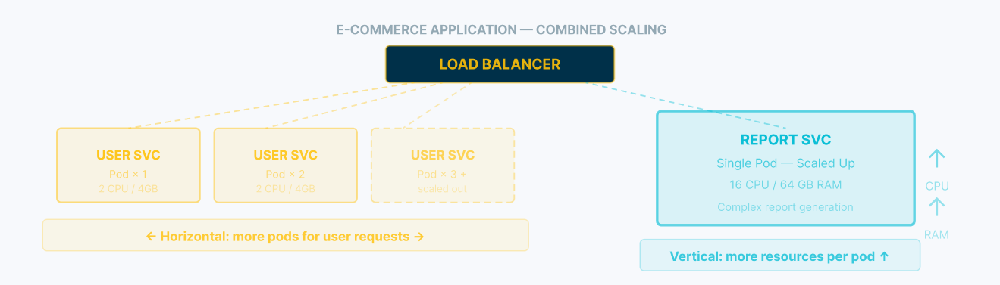
In many real-world scenarios, a combination of horizontal and vertical scalability is employed for optimal performance and resource utilization. For example, an e-commerce application might use horizontal scalability to handle a large number of user requests during normal operation.
However, during a particularly resource-intensive task, such as generating complex reports, vertical scalability can be applied to the specific service responsible for this task.
Key Benefits
Why combining Kubernetes horizontal and vertical scaling strategies delivers measurable operational value.
Kubernetes provides the flexibility to scale horizontally by adding more instances or vertically by increasing resources, allowing for tailored solutions based on the nature of the workload.
Horizontal scalability ensures that resources are distributed across multiple instances, preventing a single point of failure and improving fault tolerance. Vertical scalability ensures that critical services have the necessary resources during peak demands.
Horizontal scalability allows you to use more cost-effective, smaller instances and scale by adding more of them. Vertical scalability allows you to choose instances that match the specific resource requirements of a particular workload.